Quantum Neural Networks: Patterns in High-Dimensional Spaces
Exploring the emergent properties of entanglement-optimized neural architectures and their performance in complex probabilistic modelling.
Rigorous technical writing on quantum ML, quantum algorithms, and the future of computation. No hype. Full derivations. Cited sources.
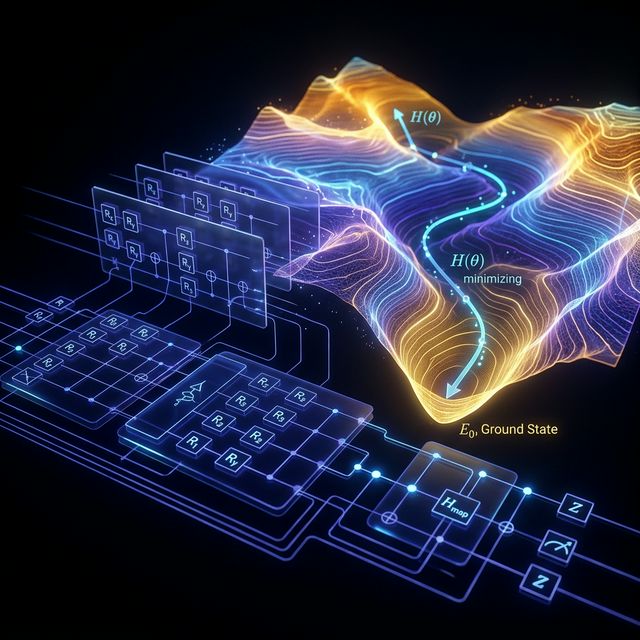
The Variational Quantum Eigensolver is the foundational algorithm of near-term quantum computing. We derive it completely — from the variational principle of quantum mechanics through the parameter-shift gradient rule to the classical optimization loop — and assess where it stands on real hardware today.
New research and analysis from the Quaniq lab
Exploring the emergent properties of entanglement-optimized neural architectures and their performance in complex probabilistic modelling.
Parameterized quantum circuits trained via gradient descent are the foundation of quantum machine learning. But do they actually converge? We derive the conditions rigorously, examine the barren plateau problem mathematically, and survey what the current literature says about trainability.
Quantum kernel methods offer a path to quantum advantage in machine learning without the trainability problems of variational circuits. We derive the quantum kernel function from first principles, prove the connection to classical SVMs, and examine when quantum kernels can outperform classical ones.
Specialized coverage across the entire quantum computing stack.
Variational circuits, quantum kernels, QNNs
12 articlesGrover, Shor, HHL, QAOA
8 articlesDirac notation, density matrices, unitaries
15 articlesWhere classical meets quantum
6 articlesPapers, roadmaps, real progress
10 articlesJoin researchers and engineers who read Quaniq to stay at the frontier of quantum computation and intelligent systems.
No spam. Unsubscribe anytime.